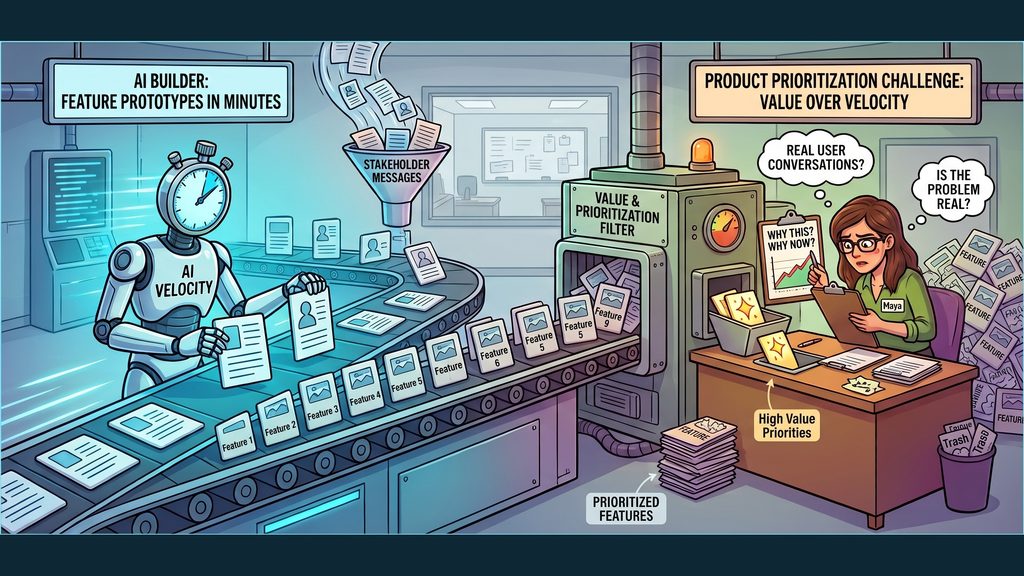
Picture this: It’s a random Tuesday, and a stakeholder drops a familiar message in Slack: “Can we add a bulk export feature? Sales really wants it.”
A year ago, Maya, a Product Owner, would have let that request simmer. She’d interview a few sales reps, check the data, and ping engineering for a gut check on the effort. Half the time, these requests quietly died before ever reaching a sprint. The friction of the process acted as a natural filter, often revealing that “sales really wants it” actually meant three vocal accounts instead of a broader market need.
But this time, Maya fed the request into an AI tool. Within minutes, she had a polished user story. By the end of the day, a working prototype was sitting in a pull request. It felt like incredible velocity. But it also meant a half-baked hallway idea was suddenly a tangible artifact. And as any seasoned product person knows, it is exponentially harder to kill a living prototype than an idea floated on Slack.
What AI didn’t fix
Here is the quiet truth about our current AI tooling: AI made Maya faster at the part of her job that was never actually the bottleneck.
I’ve seen this play out in my own work too. Drafting the story, formatting acceptance criteria, sketching a rough flow, that used to take a day or two. Now it takes an hour. What hasn’t gotten any faster is the conversation where a stakeholder finally tells you what they actually mean, three questions deeper than their original ask, or the quiet, uncomfortable stretch where an idea just sits there half-formed and the only way through it is to keep asking why. AI has nothing to offer in that stretch. It never has.
Because AI stripped away the natural friction of product development, the bottleneck didn’t vanish; it just shifted further down the pipeline. Instead of spending her time deciding what is worth building, Maya now spends it reviewing unvalidated features that have already been built. Unvalidated ideas eat up review time and engineering bandwidth just as fast as good ones do.
AI generates options and estimates effortlessly, but it cannot tell Maya:
- Whether those three sales accounts are worth prioritizing over her core roadmap.
- Whether “bulk export” is the actual need, or just a symptom of a larger workflow issue.
- If the problem is actually worth solving right now.
This gap shows up in an even sneakier place: user research itself. A growing number of product teams are asking AI to draft customer personas, synthesize research, or even predict how a segment will react to a feature, sometimes without ever having talked to a live customer. The persona that comes back reads confidently. It’s detailed, specific, easy to build a roadmap around. What’s harder to see is what it’s built from: patterns already baked into the model, not a real person Maya could call back and ask a follow-up question. It carries whatever assumptions and blind spots were already in its training data, quietly, with no label on them. A synthetic persona can feel like research. It isn’t. It’s a guess wearing research’s clothes, and most teams using it don’t realize how much bias is riding along for free.
AI made it cheaper to build a feature. It didn’t make it any cheaper to be wrong about which feature to build, or which customer you built it for.
What actually separates the teams pulling ahead
The teams pulling ahead in this landscape aren’t the ones using AI to build everything. They are the ones being ruthlessly picky about where they point it.
A BCG study of over 1,800 companies revealed a stark truth. The organizations getting real value from AI are hyper-focused on a small handful of clear priorities, rather than a sprawling list of experiments. By maintaining sharp focus, they are seeing more than double the return on their AI investments.
Maya’s team eventually figured this out. They didn’t stop using AI to accelerate execution, but they brought back one non-negotiable habit: before anything gets built, someone still has to answer “Why this, and why now?” It’s a small step, but it’s the entire job.
So, what would you actually build?
If you’re a PO or Scrum Master, you already know the pull of that Tuesday Slack message. A request lands, and it’s tempting to hand it straight to AI and see what comes back, partly because it’s fast, and partly because saying “let me check first” feels like you’re the one slowing the team down.
Here’s the harder question worth sitting with before the prototype exists: “Would you still choose to build this if it took a week instead of an hour? And would you still trust the customer behind it if you’d actually talked to them yourself, instead of asking a model to imagine them for you?”
If the answer to both is yes, build it. If you’re not sure on either count, that’s the real work. Do it before the prototype, or the persona, makes the decision for you.
Sources:
- McKinsey: Unlocking the value of AI in software development
- Atlassian: How tech leaders can turn AI hype into real team productivity
- Scrum.org: The Augmented Product Owner
- BCG: From Potential to Profit – Closing the AI Impact Gap
Further reading: Why AI Will Never Replace the Heart and Soul of Agile: The Human Touch
Image: Shruti Reddy Alikepalli. “Value over Velocity: What AI is teaching Agile teams about priorities”, Gemini, Aug 2026.


Nice Article Shruti. Very timely!