 This post captures a conversation from a PMO breakfast meeting I’ve hosted for over a decade for the PMI Silicon Valley chapter. We are a small group of experienced PM leaders from various industries. We share and learn from our best and worst practices in leading technical, functional, and organizational programs and the Project Management Office (PMO). October 14, 2026, we had a very engaging dialogue about the value-add of Artificial Intelligence for enterprises.
Artificial intelligence has rapidly transitioned from a futuristic buzzword to a daily operational reality across industries. We use AI to build automations of repeated tasks (call it Agentic AI!) Yet, as organizations rush to integrate AI into workflows – from code generation to administrative reports and summaries – Project Management Offices (PMOs) face a critical challenge: How do we balance technological speed with robust governance, security, and accountability?
During a recent collaborative PMO gathering, industry leaders and project management professionals explored these exact questions, highlighting key strategies for successfully managing AI adoption. Watch a short 2-minutes (YouTube) video aligned with this topic.
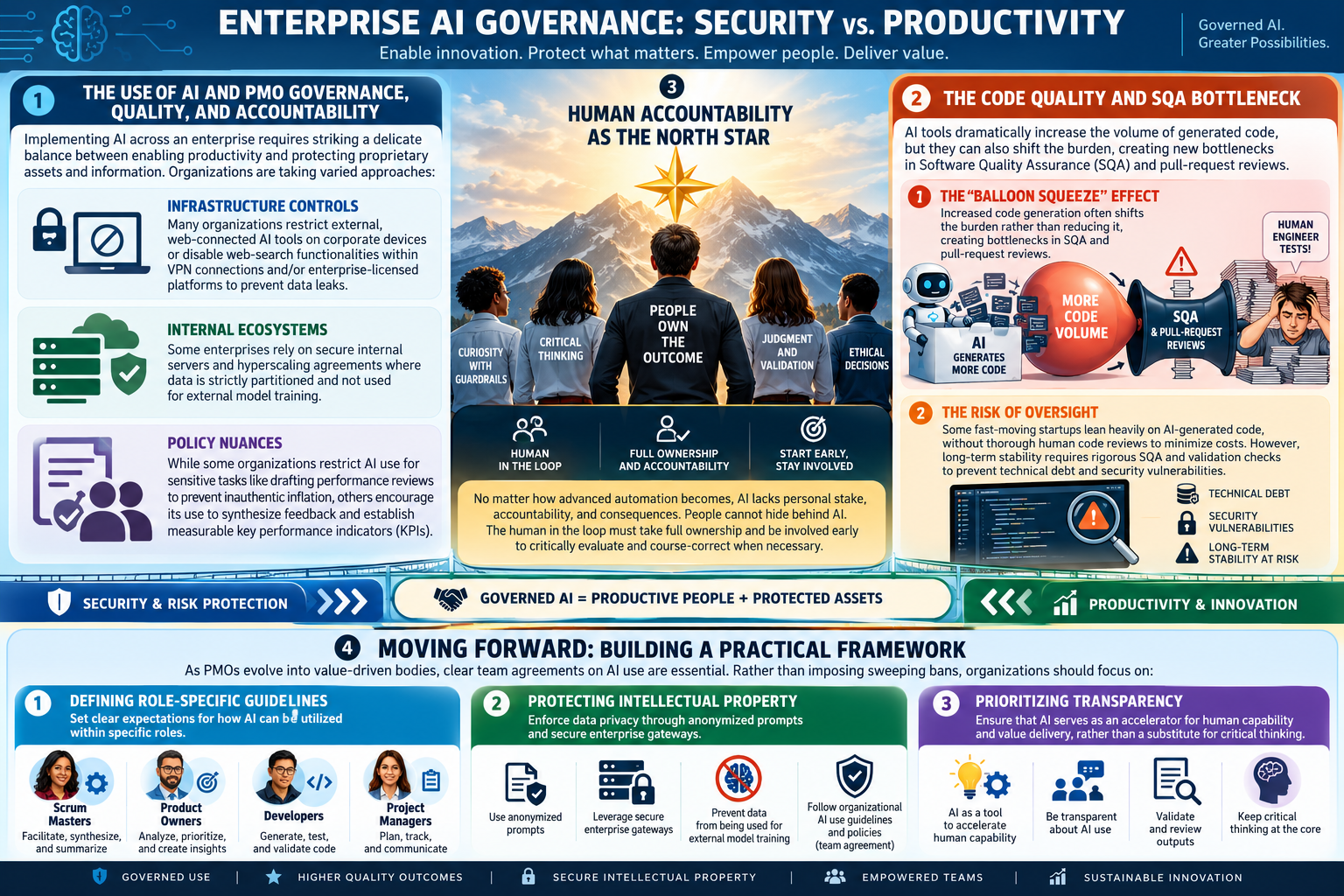
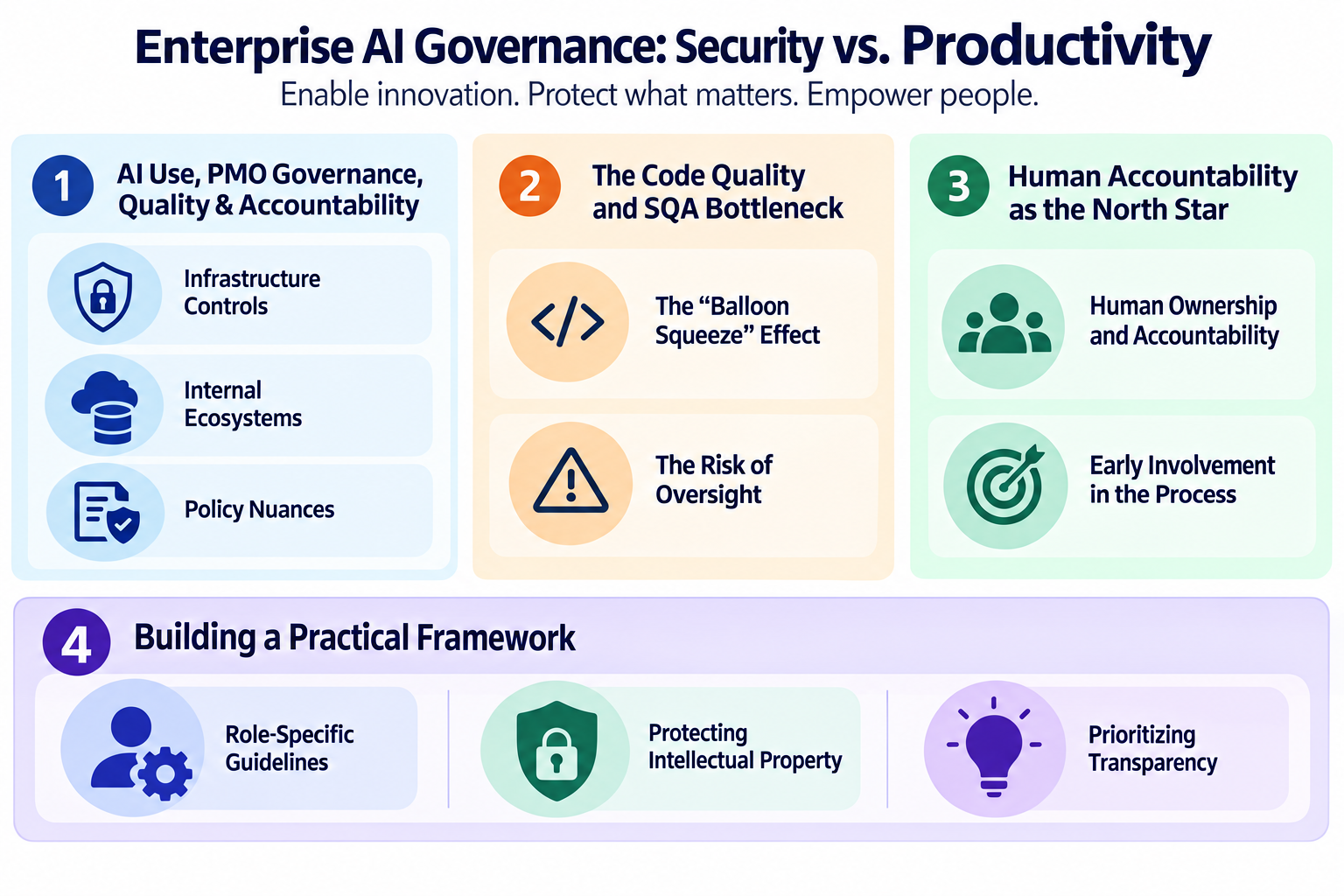
- Enterprise AI Governance: Security vs. Productivity
Implementing AI across an entire enterprise requires striking a delicate balance between enabling productivity and protecting proprietary assets and information. Organizations are taking varied approaches:
- Infrastructure Controls: Many organizations restrict external, web-connected AI tools on corporate devices or disable web-search functionalities within VPN connections and/or enterprise-licensed platforms to prevent data leaks.
- Internal Ecosystems: Some enterprises rely on secure internal servers and hyperscaling agreements where data is strictly partitioned and not used for external model training.
- Policy Nuances: While some organizations restrict AI use for sensitive tasks like drafting performance reviews to prevent inauthentic inflation, others encourage its use to synthesize feedback and establish measurable key performance indicators (KPIs).
- All of the above activities are strictly governed by AI use guidelines and policies (call it team agreement!)
- Infrastructure Controls: Many organizations restrict external, web-connected AI tools on corporate devices or disable web-search functionalities within VPN connections and/or enterprise-licensed platforms to prevent data leaks.
- The Code Quality and SQA Bottleneck
 Nowhere is AI’s double-edged sword more apparent than in software development. While AI tools dramatically increase the sheer volume of generated code (with or without guardrails and quality assurance), industry studies and discussions reveal a familiar pattern:
- The “Balloon Squeeze” Effect: Increased code generation often shifts the burden rather than reducing it, creating bottlenecks in Software Quality Assurance (SQA) and pull-request reviews (call it human-engineer tests!)
- The Risk of Oversight: Some fast-moving startups lean heavily on AI-generated code without thorough human code reviews to minimize costs. However, long-term stability requires rigorous SQA and validation checks to prevent technical debt and security vulnerabilities.
- The “Balloon Squeeze” Effect: Increased code generation often shifts the burden rather than reducing it, creating bottlenecks in Software Quality Assurance (SQA) and pull-request reviews (call it human-engineer tests!)
- Human Accountability as the North Star
No matter how advanced automation becomes, AI lacks personal stake, accountability, and consequences. PMO leaders often note that people cannot hide behind AI:
- Whether an individual is writing code, drafting customer communications, compiling project documentation, or even writing a performance review, the human in the loop must take full ownership and accountability for the output.
- Early-stage human involvement is crucial; waiting until a project or document is fully polished by AI makes it far harder to critically evaluate and course-correct when necessary.
- Whether an individual is writing code, drafting customer communications, compiling project documentation, or even writing a performance review, the human in the loop must take full ownership and accountability for the output.
Moving Forward: Building a Practical Framework
As PMOs evolve into value-driven bodies, clear team agreements on AI use are essential. Rather than imposing sweeping bans that restrain creativity, organizations should focus on:
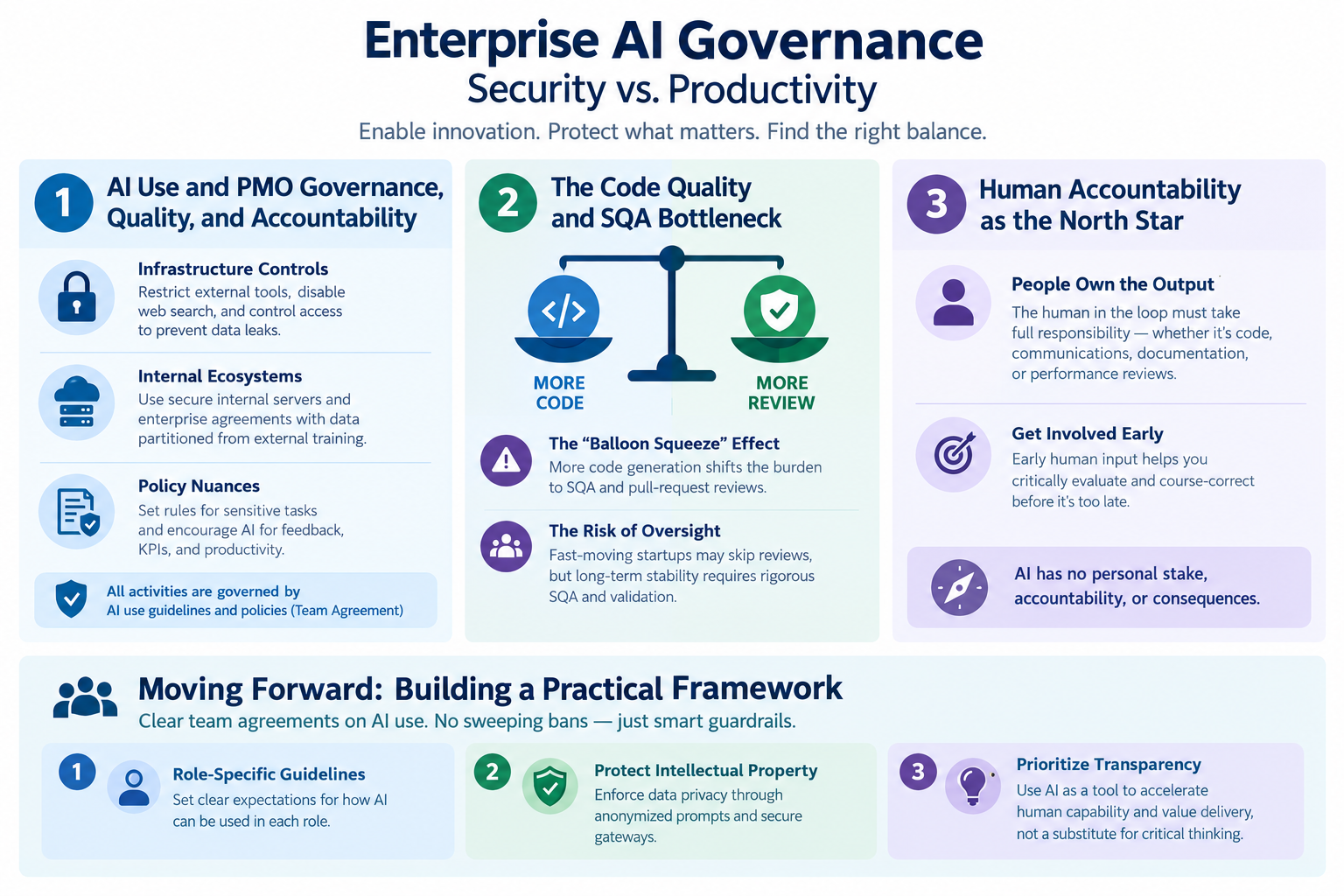 Defining Role-Specific Guidelines: Setting clear expectations for how AI can be utilized within specific roles (e.g., Scrum Masters, Product Owners, developers, Project Managers).
- Protecting Intellectual Property: Enforcing data privacy through anonymized prompts and secure enterprise gateways.
- Prioritizing Transparency: Ensuring that AI serves as an accelerator for human capability and value delivery (call it tools), rather than a substitute for critical thinking.
Watch a short 2-minutes (YouTube) video aligned with this topic.
How is your organization approaching AI governance in your PMO? Share your thoughts and join the conversation in the comments below!

