Past Events: 2026 | 2025 | 2024 | 2023 | 2022
Upcoming Event: October 29, 2026
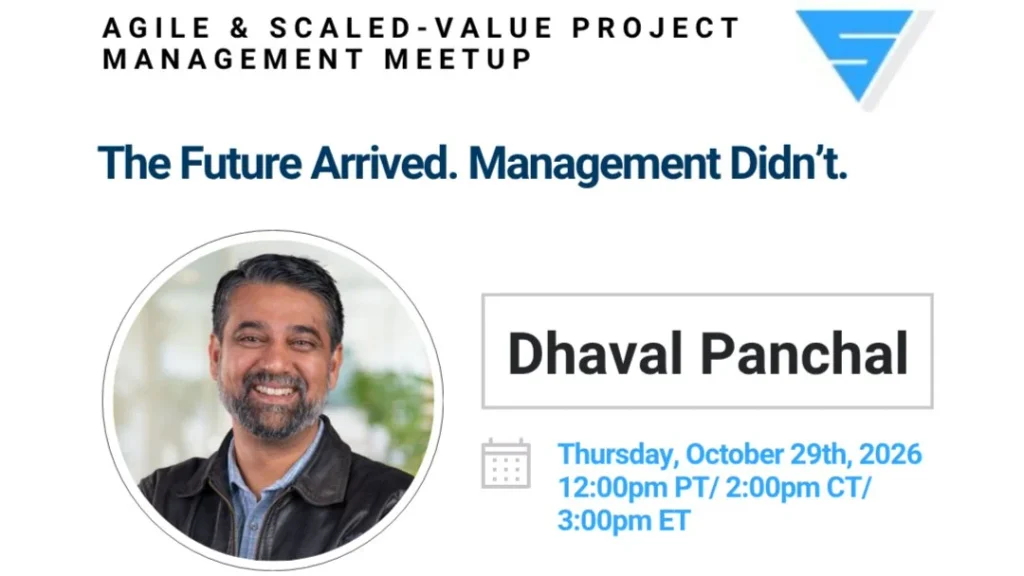
We have never had more powerful tools for building products and services. Cloud computing, AI, real-time data, simulation, and collaboration technologies have transformed what is possible. Yet projects still slip, dependencies multiply, priorities compete, and decisions slow.
The future arrived. Management didn’t.
What if these aren’t isolated problems to solve, but familiar appearances produced by recurring structural patterns?
This session explores how inherited management assumptions propagate across organizational levels, why faster feedback changed the nature of building software, and how practices intended as means can quietly become targets themselves. We’ll examine why successful rescue missions can preserve the conditions that create crises, why culture carries survivorship bias, and why copying successful organizations cannot reproduce their fitness.
Rather than searching for another model to adopt, we’ll turn the mirror around and examine the organization as a system we design. The challenge is not to finally get that design right, but to create the conditions for people to exercise judgment, encounter reality sooner, and progressively get less wrong as circumstances change.
There is no happily ever after. Progress means becoming capable of solving a better class of problems.
There is no happily ever after. Progress means becoming capable of solving a better class of problems.
Takeaways:
- Watch the work, not just the worker: Recognize how recurring structural patterns can produce familiar behaviors and problems across organizational levels.
- Distinguish means from targets: Examine when frameworks, practices, metrics, and transformations stop enabling capability and become objectives themselves.
- Design for fitness, not imitation: Understand why fitness cannot be copied—and why adaptive organizations must continually discover what works under today’s conditions.
Our Speaker:
Dhaval Panchal, NACD.DC is the Founder and President of Evolve Agility Inc. For over two decades, he has guided executives and senior leaders through complex enterprise transformations across global industries, including Energy, Financial Services, Healthcare, Insurance, and Gaming. His experience spans from the basement to the boardroom, with a focus on the systems, structures, governance, and leadership dynamics that shape organizational behavior. Rather than treating agility as an initiative, process rollout, or framework adoption, Dhaval helps leadership teams evolve their enterprise socio-technical habitats to develop adaptive capability that holds under pressure. He is the author of Evolve Agility: Evolving Culture, Structure, and Systems to Enable Adaptive Growth.
Past Events:
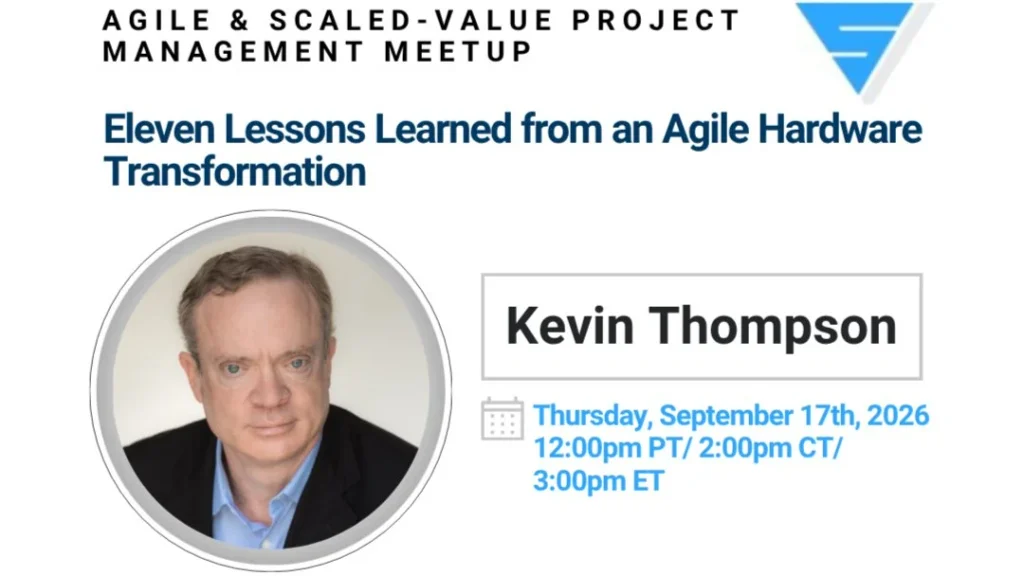
Can Scrum really work for hardware development? This presentation answers that question through a case study of an Agile transformation at Thermo Fisher Scientific involving the development of a new mass spectrometer. The engagement provided an opportunity to test predictions from my eighteen-month research project on Agile methods for hardware development. The presentation summarizes eleven practical lessons about what translates directly from Scrum, what had to be changed, and why.
Takeaways:
- Scrum itself translates surprisingly well to hardware development.
- Many software-oriented Scrum practices must be replaced with hardware-appropriate alternatives.
- Hardware work can be decomposed into Sprint-sized, testable deliverables.
- Cross-functional teams remain a key ingredient for successful Agile development.
Our Speaker:
Dr. Kevin Thompson holds a Ph.D. in Physics and has worked as a scientific researcher, software developer, project manager, Scrum Master, Agile consultant, and trainer. He has led Agile transformations across more than 100 engineering organizations, with a particular focus on hardware and embedded-systems development. He is the author of the book Solutions for Agile Governance in the Enterprise, and specializes in helping engineering organizations adapt Agile methods to complex hardware environments.
