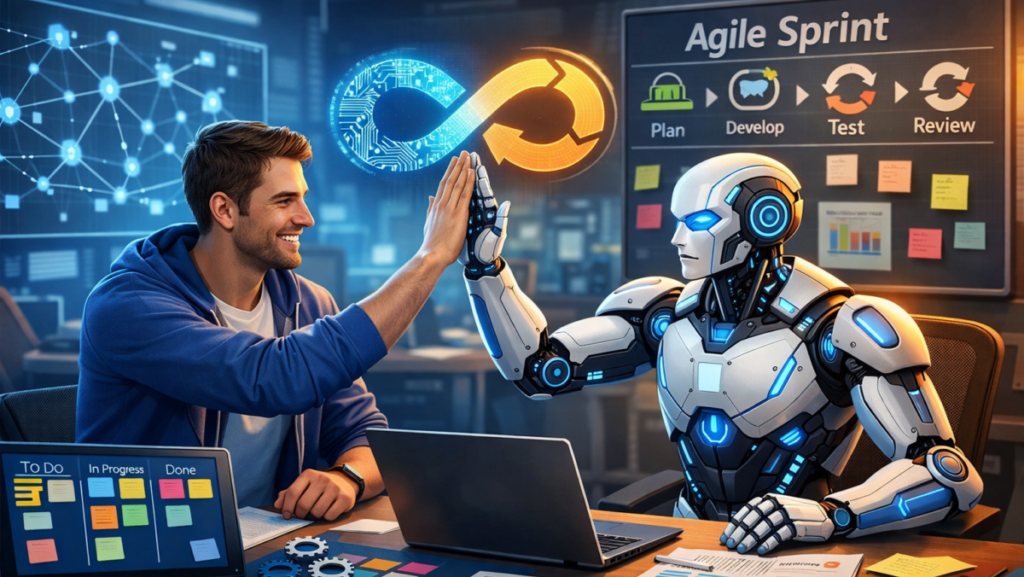
Part 2 : The AI Era Job Seeker’s Playbook
When companies restructure, they optimize for an AI-first operating model. Job seekers who position themselves as leaders of this new AI model are in high demand.
1. Master the AI “Co-pilot”: Show, Don’t Just Tell!
AI literacy is your new foundation. Certifications matter, but demonstrated proficiency matters more.
- For Scrum Masters: Go beyond understanding the Scrum framework. Show you know how to leverage AI tools for predictive planning and automated flow metrics. Understand how AI coding tools affect team composition and velocity.
- For Product Owners: Deepen your skills in data analytics and customer intelligence platforms. Learn to use GenAI tools for creating rapid prototypes, generating synthetic user data for testing, and drafting initial user stories. Master the art of translating AI insights into actionable product backlogs.
Actionable Step: List experience or get certified with specific AI-Agile integration platforms (e.g., Jira’s integrated AI, Azure DevOps’ AI features, specialized automation plugins) on your resume
2. Focus on Human Skills: Emotional Intelligence & Judgement
While AI can automate logic, it cannot replicate complex human interaction. Focus on these essential skills that AI cannot easily replace:
- Complex Emotional Intelligence (EQ): Psychological safety is key to guiding teams through technological changes.
- Ethical Judgement: AI can analyze data, but it cannot make ethical decisions. Agilists must address bias and ethical risks in AI-driven systems.
- Strategic Negotiation & Stakeholder Management: Stakeholders are increasingly data-driven, so Product Owners must negotiate effectively to balance priorities and build consensus.
- Cross-Functional Collaboration and Systems Thinking: Connecting across data science, marketing, and legal is critical. Scrum Masters must help teams to see their work in the broader value stream.
Actionable Step: Invest in training and experience in negotiation, conflict resolution, and leading through change.
3. Shift from “Process Manager” to “Value Optimizer”
Companies don’t want Agilists who just “Do Scrum”—they want results. In 2026, you optimize end-to-end value flow from ideation to delivery, not just manage sprints.
- Understand DevOps and Platform Engineering: Agile and DevOps are converging. Understanding CI/CD, automated testing, and cloud infrastructure is essential to see how AI impacts delivery pipelines
- Embrace Product-Led Growth (PLG): Product Owners should understand PLG principles leveraging data, AI, and self-service experiences to drive acquisition. At the same time, they must balance this with customer-led strategies, collaborating closely with marketing, sales, and customer success teams to drive retention, expansion, and long-term value
- Focus on Outcomes over Outputs: Shift your metrics from velocity (how much we did) to cycle time to value (how quickly we delivered a usable feature).
- Learn Value Stream Management: Understand how to map the entire flow from concept to delivery, using AI to identify waste and optimize the overall system.
4. The Agile Job Hunt in 2026: Position Yourself as an Evolution, not a Relic
The AI-Ready Resume:
Keywords Matter: Instead of just “Scrum Master,” use “AI-Enabled Agile Lead.” Instead of “Product Owner,” use “AI-Driven Product Strategist.”
- Quantify Impact (Especially AI Impact): Replace generic Agile actions with measurable AI-driven outcomes – e.g., “leveraged AI predictive analytics to improve sprint predictability by 30%” or “used AI sentiment analysis to prioritize backlog, increasing user satisfaction by 15%.”
Showcase Technical Fluency: List experience with specific AI tools (e.g., Copilot, ChatGPT, specialized Agile AI extensions) and other data platforms.
The 2026 Interview Strategy:
- Demonstrate Hybrid Team Leadership: Be prepared to answer questions like: “How would you handle conflict between a human developer and suggestions provided by an AI coding assistant?” or “How do you ensure the human element of Scrum is not lost in a data-driven environment?”
- Focus on Adaptability and Learning: Emphasize your continuous learning mindset. Describe specific instances where you learned a new technology rapidly and applied it to your Agile practice.
- Provide STAR Solutions, Not Just Frameworks: When presented with a problem, don’t just say, “I’d use Scrum”, use STAR-based responses to show how you apply Agile with data and AI-driven insights.
Conclusion
The future isn’t AI replacing Agile professionals—It’s professionals evolving with AI. The year 2026 isn’t the end of Agile or Scrum – it’s their transformation. In a world of constant layoffs, standing still is no option. Treat Agile as more than just meetings—what truly matters now is
• Embracing AI • Blending data with empathy • Delivering real human value
It’s no longer about knowing the process. It’s about maximizing impact with the future-ready tools. In a volatile market, leaders who combine AI with human insight will always stay in demand. Finally, if you are looking to gain knowledge and hands-on experience with Agile, I encourage you to consider SVPM. To learn more and find out how you can become part of this community, check out SVPM or find us on LinkedIn.
References:
- McKinsey Global Survey: High-performing AI organizations are 3x more likely to fundamentally redesign their workflows rather than just adding AI tools to old processes. Don’t forget to read this: Agile Practitioners Should Be Optimistic for 2026
- Forrester Research: Predictions 2026 (Software Development) – Predictions 2026: Software Development Goes From Jamming To A Full Orchestra
- Economic potential of generative AI | McKinsey
- Product-Led Growth: What It Is and Why It’s Here to Stay
- People & Organizational Performance | McKinsey & Company
- Image reference – ChatGPT AI and Agile Teamwork

